The 3-Month Onboarding Problem: Why Your New Engineers Are Still Lost
By Norbert Wlodarczyk
Your team is growing. Your velocity isn’t. Here’s what’s actually going wrong in the first 90 days.
The real cost of slow developer onboarding
You hired four engineers last quarter. Each one took somewhere between three and six months to ship anything meaningful without blocking a senior teammate. That’s not unusual. A survey of over 80 engineers and engineering managers found the average ramp-up time for new engineers is three to nine months. In some companies it approaches a year.
Do the math on a 60-person engineering org. If you’re hiring 15 people a year and each one is at half capacity for five months, that’s 30 person-months of lost output. At a fully-loaded salary of $200K, you’re looking at roughly $1M in wasted productivity annually. Not because the people are bad. Because they can’t find what they need to do the work.
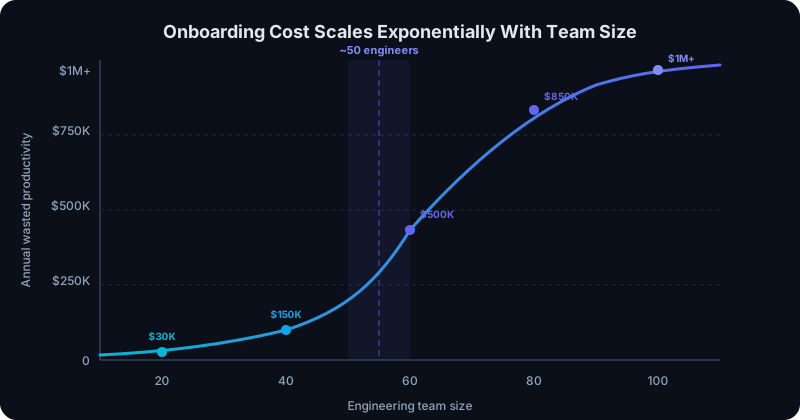
And then there’s the fallout you don’t measure: 33% of new hires quit within their first 90 days. One in three, gone before they ever became productive. Often because the experience of joining felt like archaeology, not engineering.
What new engineer onboarding actually looks like
Here’s a pattern we see constantly. A mid-level engineer joins a company of 100+ people. She’s smart, motivated, ready to contribute. And then:
Every task requires three Slack DMs and a 30-minute call just to understand why the architecture is the way it is. The Confluence docs are two years out of date. The person who wrote them left six months ago. She asks the same question to four different people and gets four different answers.
The first 90 days aren’t spent building. They’re spent navigating. Three Slack channels for one question. A wiki page that might be current, or might reflect an architecture from two refactors ago. A senior engineer who knows the answer but is in back-to-back meetings until Thursday.
This isn’t a training gap. It’s an orientation gap. The knowledge exists. It’s just not reachable by someone who doesn’t already know where to look. And the format matters - chunked, connected information outperforms massive documents every time, yet most companies still default to the monolithic wiki.
Why onboarding breaks at 50 engineers
Small teams don’t have this issue. At 20 people, everyone knows who built what. Hallway conversations carry institutional context. “Just ask Sarah” is a viable knowledge management strategy.
Then you cross roughly 50 engineers, and the math changes. Robin Dunbar’s research on cognitive limits suggests humans maintain about 150 stable relationships, but meaningful working relationships top out much lower. At 50 people, the number of possible communication paths is 1,225. At 100, it’s 4,950. The informal knowledge network that worked beautifully at 30 people doesn’t scale. It fragments.
What happens next is predictable:
- “Just ask Sarah” becomes a bottleneck. Sarah is now answering the same context questions from every new hire, every quarter. Her own output drops. She starts declining pairing requests.
- The onboarding doc gets forked. Then forked again. Nobody knows which version is current, so new hires read all three and trust none.
- New engineers learn quickly that the fastest path to answers is interrupting someone senior. So they do. Repeatedly. The existing team loses hours of focused work per week to ad-hoc questions that should have been answerable without them.
The result? A measurable 42% decrease in development velocity across teams with poor knowledge practices. Not because people stopped working hard. Because the knowledge required to work effectively became scattered, stale, and locked in individuals rather than systems.
The hidden productivity cost of mentoring new engineers
There’s a second cost nobody budgets for: what onboarding does to the people who are already there.
Senior engineers lose up to 30% of their own productivity mentoring new hires when there’s no structured path. Your staff engineer who carries half the institutional context in her head? She’s fielding the same “why is this built this way?” question from every new hire, every quarter. She’s 60% consultant, 40% engineer, and increasingly considering a role at a company where she can actually build things again.
Sprint velocity drops 25-40% during team integration. That’s not the new hire’s fault. It’s the cost of using human beings as a knowledge retrieval system. Every interruption pulls a senior contributor out of flow state, and research by Gloria Mark at UC Irvine shows it takes an average of 23 minutes to regain focus after an interruption. That’s not a five-minute detour. That’s a destroyed afternoon.
The math compounds. If you’re hiring 15 engineers a year and each one requires 2-3 hours of senior mentoring per day for the first month, you’re burning roughly 1,000 hours of your most experienced people’s time. Not on building. On repeating what they already explained last quarter to the previous new hire.
How top engineering teams onboard in 3 weeks
The companies that get onboarding down to three to four weeks aren’t writing more documentation. They’re approaching the problem from a different angle entirely.
They design for the new hire’s first question, not the expert’s last answer. Most internal docs are written by the person who knows the system best. They skip context that feels obvious to the author: why this architecture, who owns what, which past decisions still hold. Google’s own onboarding research confirmed that the top hindrances to ramping up are learning new technology, poor or missing documentation, and finding expertise. Fast-onboarding teams write for the person who joined last Monday and has zero context. That means every explanation starts with “why,” not “how.”
They make the org chart of knowledge explicit. A new engineer’s real blocker isn’t the code. It’s knowing who to ask, which team owns what, and where the boundaries are between services. Companies that onboard fast have this mapping visible and current. Not in a spreadsheet someone updates quarterly.
They create paths, not libraries. A wiki with 500 pages is a library. A new hire doesn’t need a library. They need a guided path: here’s your team’s domain, here’s what depends on it, here are the three decisions that shaped it, here’s who made them. The difference between a three-month ramp and a three-week ramp is often just the difference between “go read the docs” and “follow this trail.”
They treat onboarding feedback as a diagnostic. Every question a new hire asks that they couldn’t answer themselves is a signal. Not a signal that they’re slow. A signal that something is unfindable, outdated, or missing. Teams that track these questions systematically can see exactly where their knowledge infrastructure is failing, and fix it before the next hire arrives.
They assign a buddy, not just a manager. A manager checks in weekly. A buddy answers the question you’re embarrassed to ask in standup. The difference: a low-friction contact who isn’t evaluating you.
Google’s onboarding research found buddies reduced new hire ramp time by 25%. The key is that the best buddies are proactive, not passive. “What are you stuck on? What couldn’t you find this week?” is a fundamentally different dynamic than waiting for the new hire to raise a hand. It also distributes the mentoring load across the team instead of funneling every question through one staff engineer.
They have tooling ready before day one. New engineers still spend their first two days waiting for repo access, CI pipeline permissions, or staging credentials. Every hour filing IT tickets is an hour not learning the codebase.
The fix is simple: treat access provisioning as a checklist completed before the start date. Version control, deployment tools, monitoring dashboards, communication channels, documentation platforms. All of it, ready on login. The only barrier on Monday morning should be understanding the code, not waiting for a Jira service desk approval.
They share the why, not just the what. Most onboarding is task-oriented: here’s your repo, here’s the ticket, here’s the deployment process. What’s missing is purpose.
What are the team’s KPIs? What does success look like this quarter? Why does this service exist? When a new engineer understands the goals, they make better decisions about priorities, acceptable shortcuts, and trade-offs that matter. Without that framing, they execute tasks and wait for instructions. With it, they think like a team member.
The difference between “deploy this feature” and “we’re trying to reduce checkout abandonment by 15% this quarter, and this feature is how” is the difference between a task executor and someone who can make judgment calls on their own.
Why delaying onboarding improvements costs more every quarter
Every month you delay fixing this, you’re paying twice. Once for the new engineers who are underproductive for months. And again for the senior engineers who are burning out answering the same questions instead of building.
If your team is past 50 engineers and new hires are still spending their first quarter just figuring out how things work, the problem isn’t effort or talent. It’s that nobody designed the path from “day one” to “productive contributor,” and you’re paying for that gap in salary, senior engineer burnout, and early attrition.
That’s the problem we built Nexalink to solve. But whether or not you use our tool, try this: ask your most recent hire how long it took before they could answer a question about the codebase without messaging someone. That number is your onboarding score. And it’s probably worse than you think.