The Real Cost of Bad Documentation in Engineering
By Norbert Wlodarczyk
Bad documentation isn’t a quality-of-life issue. It’s a budget problem. And most engineering leaders have no idea how large the number actually is.
The number nobody calculates
Here’s a question for every VP of Engineering: how much did bad documentation cost you last year? Not in frustration. In dollars.
Most leaders can’t answer this. They’ll acknowledge the problem exists. They’ll nod when someone complains about outdated Confluence pages. But they’ve never run the math, because the cost is distributed across hundreds of small moments that never show up on a P&L.
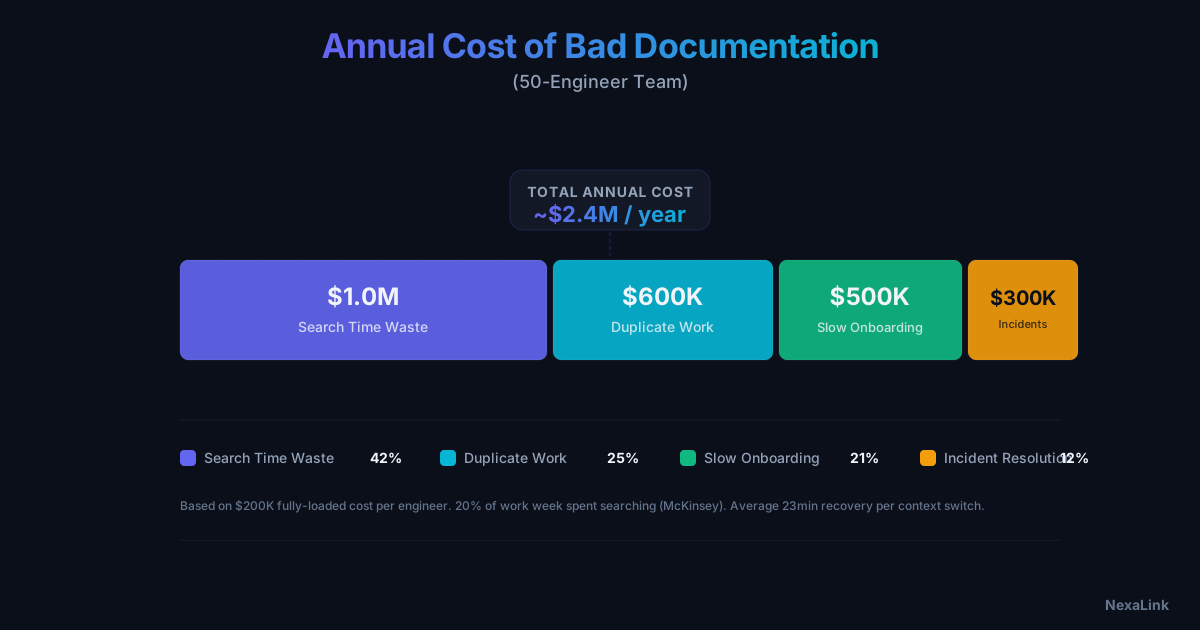
Those moments add up to something concrete. IDC research found that knowledge workers spend 20% of their work week searching for information or tracking down colleagues who can help them find it. For a 50-engineer team at a fully-loaded average of $200K per engineer, that’s $2M a year spent not building. Just searching.
And that’s the conservative estimate. The real cost has three layers that compound on each other.
Layer 1: The search tax
The search tax is the most visible and most frequently cited cost. It’s the time engineers spend looking for information that should be immediately available.
McKinsey’s research on developer velocity found that companies with strong documentation practices see a measurable 42% improvement in development velocity compared to those without. Read that again. Not a 5% edge. A 42% gap.
For a 50-person engineering team, the math works like this:
- Average fully-loaded cost per engineer: $200,000/year
- Hours per year per engineer: ~2,000
- Time lost to information searching: 20% (IDC) = 400 hours/engineer/year
- Cost of search time: 50 engineers x 400 hours x $100/hour = $2,000,000
Not all of that is recoverable. Engineers will always need to search for some things. But if even half of that search time is caused by documentation that’s missing, outdated, contradictory, or unfindable, you’re looking at $1M in waste from search alone.
Layer 2: The interruption cost
The search tax accounts for the person looking. It doesn’t account for the person being found.
When documentation fails, engineers default to asking a colleague. That question costs both parties. Research by Gloria Mark at UC Irvine showed it takes an average of 23 minutes to recover focus after an interruption. A “quick question” that takes two minutes to answer actually costs 25 minutes of productive time for the person who was interrupted.
In most teams, the interruptions aren’t evenly distributed. They concentrate on the two or three people who hold the most institutional context. Those are typically your most senior, most expensive engineers. The ones you need in flow state the most.
A senior engineer fielding five documentation-related interruptions per day loses over two hours of focused work. Across a year, that’s roughly 500 hours - a quarter of their total capacity redirected from building to answering questions that a functional knowledge base would have handled.
At senior compensation levels, this layer alone adds $150K-$250K per team. And it doesn’t show up in any dashboard.
Layer 3: The decision cost
This is the layer that nobody tracks and that causes the most damage.
When engineers can’t find the context behind past decisions, they make new decisions without it. Sometimes they re-litigate something that was already resolved. Sometimes they build on an assumption that was quietly superseded months ago. Sometimes they duplicate work that another team already completed but never surfaced.
A study from Stripe estimated that developers spend 42% of their time dealing with technical debt and maintenance. While not all of that traces back to documentation, a meaningful portion stems from decisions made without access to prior context - the kind of context that was discussed in a Slack thread six months ago, agreed upon in a meeting nobody documented, and now lives exclusively in the memory of someone who transferred to another team.
The decision cost is the hardest to quantify but the simplest to illustrate. Ask any engineering manager: in the last quarter, how many times did your team discover, mid-sprint, that they were building something that conflicted with an existing decision or duplicated prior work? Multiply each instance by the cost of the wasted sprint time. The number will not be small.
The formula: calculate your own waste
Here’s a framework you can take to your CFO. Adjust the inputs to your team’s numbers.
Annual cost of bad documentation =
(A) Search waste: [Number of engineers] x [Fully-loaded salary] x [% of time searching for info] x [% of searches caused by bad docs]
(B) Interruption waste: [Number of senior engineers regularly interrupted] x [Interruptions per day] x [25 min recovery cost] x [Working days per year] x [Hourly rate]
(C) Decision waste: [Sprints per year with rework caused by missing context] x [Average sprint cost of rework]
Total = A + B + C
For a 50-engineer team, realistic inputs produce a number between $1.5M and $2.5M annually. For 100 engineers, it approaches $5M. These aren’t theoretical projections. They’re the sum of individually small costs that nobody aggregates because they’re distributed across every team, every sprint, every day.
Why the number keeps growing
Bad documentation doesn’t stabilize. It compounds.
Every month your team operates, new decisions get made, new systems get built, and new context gets created. If the rate of knowledge creation exceeds the rate of knowledge capture, the gap widens. And every new hire who joins has to navigate that widening gap during their first three months of archaeology.
At 20 engineers, the gap is manageable. Informal networks and institutional memory fill the holes. At 50, the informal network fragments and the holes start causing visible damage. At 100, the compound cost has typically grown large enough to justify a dedicated investment - but by then you’re also dealing with years of accumulated knowledge debt that makes any solution harder to implement.
This is why the ROI calculation matters. Not because the problem is invisible. Everyone on your team already feels it. But because “our docs are bad” doesn’t get budget. “$2.4M in annual productivity waste, recoverable by 30-50% with structured knowledge management” does.
What the budget justification looks like
If you’re building the case for your leadership team, here’s the structure that works:
The problem, quantified. Use the formula above with your team’s actual numbers. Show the search tax, the interruption cost, and at least two concrete examples of decision waste from the past quarter. Specificity is what separates a complaint from a business case.
The benchmark. McKinsey’s 42% velocity gap between documentation-strong and documentation-weak teams provides the external validation. Your internal numbers provide the local urgency.
The recovery target. You won’t eliminate all documentation waste. A realistic target is reducing it by 30-40% in the first year. On a $2.4M annual waste figure, that’s $720K-$960K in recovered productivity. Frame it as engineer-hours returned to building, not as a cost saved - leadership responds better to velocity gains than to accounting exercises.
The investment. Whatever solution you propose - tooling, dedicated technical writers, process changes, or a combination - benchmark it against the recovery target. If the investment is $200K and the expected recovery is $700K, the ROI is straightforward.
Where most teams start wrong
The instinct is to write more documentation. Create a docs sprint. Mandate that every PR includes a doc update. This almost never works. Engineers resist it because it adds friction to their workflow, and even when they comply, the result is a growing pile of documents that nobody can navigate and nobody trusts.
The problem isn’t volume. Most engineering teams have plenty of documentation. The problem is that the documentation isn’t connected, isn’t current, and doesn’t reflect how knowledge actually flows through an organization.
Knowledge in an engineering team isn’t a library of independent documents. It’s a network of decisions, contexts, people, and systems that relate to each other in specific ways. A decision about your API versioning strategy connects to the service it affects, the incident that prompted it, the team that made it, and the three earlier decisions it replaced. Flat document stores can’t represent these relationships. So the documents exist, but the understanding doesn’t transfer.
This is the problem we’re solving at Nexalink - structuring enterprise knowledge as a connected graph so that information is findable by context, not just by keyword. But regardless of the tooling you choose, the first step is the same: run the numbers. Know the actual cost. The size of that number tends to clarify everything that comes next.