What Happens to Knowledge When Your Team Crosses 50 Engineers
By Norbert Wlodarczyk
There’s a phase transition in every growing engineering org. One quarter, your team feels fast, aligned, and self-correcting. The next, people are duplicating work, making decisions without context, and asking questions that were answered six months ago in a Slack thread nobody can find.
The shift doesn’t happen because you hired the wrong people. It happens because of math.
The communication paths formula
In 1970, Melvin Conway observed that organizations design systems that mirror their communication structures. But there’s a more fundamental problem lurking underneath. The number of possible communication paths in a team of n people is n*(n-1)/2.
At 10 engineers, that’s 45 paths. Manageable. Everyone roughly knows what everyone else is working on. At 25, it’s 300. You’re starting to lose track, but Slack channels and standups compensate. At 50, it’s 1,225. At 100, it’s 4,950. At 200, it’s 19,900.
This isn’t a linear increase. It’s quadratic. And each path represents a potential channel where knowledge can be created, shared, lost, or contradicted. The informal systems that worked at 20 people - hallway conversations, “just ask Sarah,” tribal memory - don’t degrade gracefully. They collapse.
Research from Harvard Business School found that the time employees spend on collaborative activities has increased by 50% over the past two decades. In engineering organizations past the 50-person mark, much of that collaboration isn’t building. It’s searching, asking, re-asking, and waiting.
The wiki wall
Most teams respond to knowledge scaling problems the same way: they buy a wiki. Confluence, Notion, GitBook, or a docs-as-code setup in the repo. The tool varies. The failure mode doesn’t.
Flat document stores cannot represent how knowledge actually connects. A wiki page about your payment service exists in isolation. It doesn’t know that an architecture decision from last November changed how retries work. It doesn’t know that the runbook it references was partially superseded by a post-incident action item three weeks ago. It doesn’t know that the team who wrote it was reorganized and the new owners have a different mental model of the system.
Knowledge in a real engineering org is a graph. Decisions reference other decisions. Documents depend on context from conversations. Systems connect to the teams that built them, the incidents that shaped them, and the constraints that explain why they look the way they do. When you flatten all of that into a list of pages with a search bar, you lose the structure that makes knowledge usable.
This is why engineers consistently report that documentation exists but isn’t trustworthy. A 2023 survey by Stack Overflow found that over 80% of developers use documentation regularly, yet internal documentation consistently ranks among the top frustrations. The docs are there. The connections between them aren’t. And without connections, every page is an island that might be current or might be an artifact from two architectures ago.
The exact moment knowledge becomes a liability
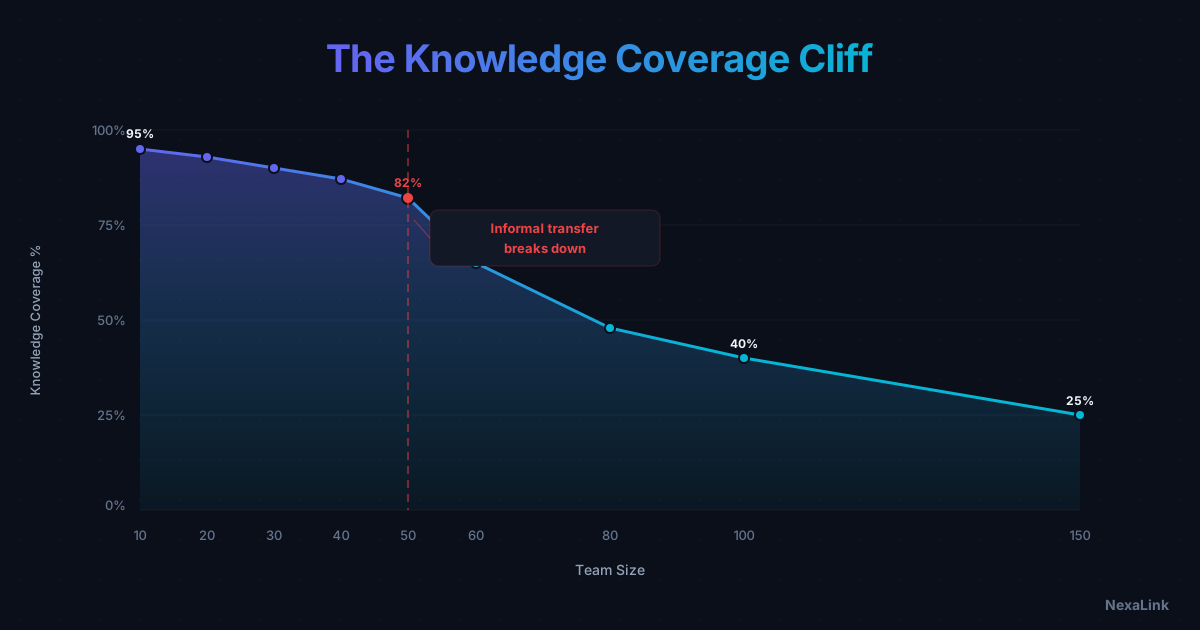
There’s a threshold - typically between 40 and 60 engineers - where knowledge transitions from an asset to a liability. Before this point, most of the team’s accumulated knowledge accelerates work. People know the systems, know the history, and can make informed tradeoffs quickly.
After this point, the volume of knowledge exceeds any individual’s capacity to hold it. And the systems you’ve built to externalize it (wikis, READMEs, onboarding docs) weren’t designed for the complexity you now have. Three things happen simultaneously:
Knowledge conflicts emerge. Two teams make contradictory architectural decisions because neither knew about the other’s work. A document written in January says one thing; a Slack thread from March says the opposite. Nobody knows which is current. Both are plausible. Engineers start making judgment calls based on incomplete information, and some of those calls are wrong.
Discovery costs explode. McKinsey research estimates that knowledge workers spend 19% of their time searching for and gathering information. In engineering orgs past 50 people, that number climbs. Every task requires a preliminary research phase: who owns this? Where’s the doc? Is this doc current? Who can I ask? Is the person I’m asking even the right person anymore?
Onboarding becomes archaeology. New hires don’t just need to learn the codebase. They need to reconstruct the decision history, ownership map, and social graph of the entire organization. At 50+ engineers, that process stretches to three to six months - not because the work is hard, but because the knowledge required to do the work is scattered across dozens of systems and hundreds of conversations.
The compounding effect is what makes this a true scaling cliff, not a gradual slope. Each new engineer adds communication paths, creates new knowledge, and needs to absorb existing knowledge. The system gets harder to maintain at exactly the rate you’re adding people to maintain it.
Why adding more documentation makes it worse
The intuitive response is to document more. Create a documentation culture. Write things down. This is well-intentioned and insufficient.
The problem isn’t the volume of documentation. It’s the lack of structure connecting it. Adding more pages to a flat wiki is like adding more books to a library with no catalog, no shelving system, and no librarian. The information density increases, but the findability doesn’t.
Cognitive load theory, as developed by John Sweller, distinguishes between intrinsic complexity (the actual difficulty of the material) and extraneous load (the difficulty imposed by how the material is presented). Most engineering knowledge management systems maximize extraneous load. The knowledge itself isn’t that complex. Finding it, verifying it, and understanding how it connects to what you’re working on - that’s where the cognitive overhead lives.
At scale, this overhead becomes the dominant cost. A team of 100 engineers, each losing even 30 minutes a day to knowledge friction, is burning 50 engineer-hours daily. That’s more than six full-time engineers worth of output, evaporated into search, context-switching, and re-asking questions that have been answered before.
What actually works at scale
The teams that navigate this transition successfully share a few characteristics. None of them are “write more docs.”
They model knowledge as a graph, not a library. Instead of storing documents as independent pages, they represent the relationships between them. This decision superseded that one. This service depends on that team’s API. This runbook was updated after that incident. When knowledge has structure, engineers can navigate it instead of searching for it.
They make knowledge maintenance a system, not a habit. Individual discipline doesn’t scale. What scales is tooling that surfaces stale content, flags contradictions, and tracks which knowledge is actually being used. The teams that keep their knowledge base healthy past 50 engineers aren’t relying on heroic documentation efforts. They’re relying on systems that make decay visible.
They reduce the cost of capturing context. If writing a decision record takes 30 minutes, it won’t happen consistently. If it takes 5 minutes because the tooling pre-populates context from the relevant threads, repos, and documents, it becomes a realistic part of the workflow. The capture cost determines the capture rate. At scale, that rate determines everything.
They connect knowledge to the work. The best time to surface relevant context is when an engineer is about to make a decision, not after they’ve already made the wrong one. Teams that integrate their knowledge systems into their development workflow - surfacing related decisions when a PR touches a certain service, showing ownership context in the IDE - reduce the discovery cost to near zero.
The cliff is predictable
The scaling cliff between 40 and 60 engineers isn’t a surprise. It’s a well-documented phase transition in organizational complexity. What’s surprising is how few teams prepare for it.
If you’re at 30 engineers and growing, the time to think about knowledge architecture is now - not when you’re at 80 and already paying the compound cost of fragmented institutional memory. The communication paths formula is unforgiving. At your current headcount, the math might still be on your side. It won’t be for long.
This is the problem we built Nexalink to solve - not by adding another wiki, but by modeling your organization’s knowledge as the connected graph it actually is. Decisions linked to the context that produced them. Documents connected to the teams, services, and conversations they relate to. Structure that scales with your team instead of collapsing under it.
Start by running the numbers. Take your engineering headcount, plug it into n*(n-1)/2, and ask yourself: does our knowledge infrastructure support that many communication paths? If the honest answer is no, you’re already on the cliff. The only question is how far down it goes.