Knowledge Graphs vs Vector Search vs Wikis: An Honest Architecture Comparison
By Norbert Wlodarczyk
A backend engineer joins your company on Monday. By Wednesday, she needs to understand how the payment service handles retries. She searches Confluence. Three pages come back. One describes the original implementation. One is a design doc for a migration that may or may not have shipped. The third is a runbook that references a config flag she can’t find in the codebase.
She spends 40 minutes reading. She still doesn’t know the answer. She messages a senior engineer on Slack.
This is not a search quality problem. It’s an architecture problem. The way your organization stores and connects knowledge determines whether people can find what they need - or whether they default to interrupting the person who built it.
Three approaches dominate the market right now: wikis, vector search, and knowledge graphs. Each one makes fundamentally different assumptions about how knowledge works. Those assumptions determine where each approach breaks.
Wikis: the default that nobody chose
Most engineering teams end up on a wiki not because they evaluated alternatives, but because someone set up a Confluence space in 2019 and it stuck. Notion, Confluence, Google Docs, SharePoint - the specific tool varies, but the architecture is the same: flat collections of documents with optional hyperlinks between them.
Wikis solve the authoring problem well. They’re easy to write in, easy to organize with folders or tags, and familiar to everyone. The barrier to creating a page is close to zero, which is exactly why most organizations have thousands of them.
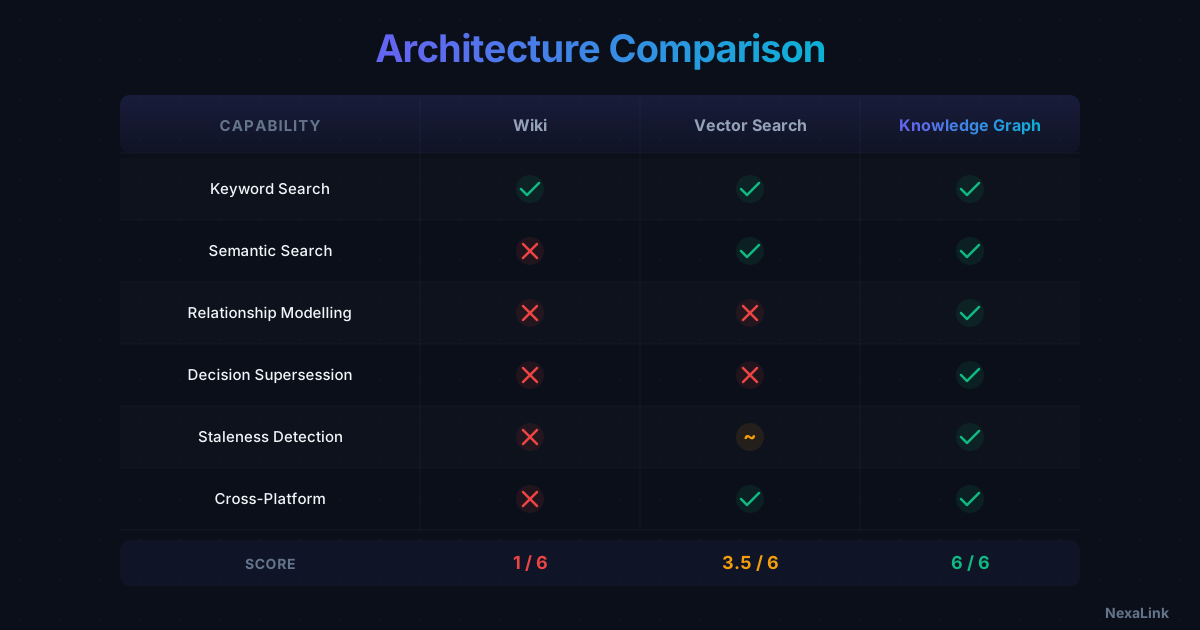
The structural problem is that wikis treat every document as equally current until a human manually says otherwise. There’s no mechanism for expressing that Document B supersedes Document A. No way to model that a decision in one page invalidates a procedure described in another. The links between pages are optional, untyped, and rarely maintained.
Atlassian’s own research found that knowledge workers spend roughly 20% of their work week searching for internal information or tracking down colleagues who can help. Wikis contribute directly to this problem. When 2,000 pages all look equally valid, search returns noise - and the engineer defaults to asking a person instead of reading a page.
Wikis also fail at relationship modelling. They can tell you that a page about “retry logic” exists. They cannot tell you that the retry logic was changed six months ago because of a rate-limiting policy on a third-party API, documented on a different page, owned by a different team. Those connections live in people’s heads. This is how tribal knowledge forms - not because people refuse to write things down, but because the tool they write in can’t express the relationships between what they wrote.
Where wikis work: Small teams (under 30 people) with low document volume and strong writing culture. Personal knowledge bases. Onboarding checklists where content is linear and doesn’t reference other systems.
Where wikis break: Past 500 pages. Cross-team knowledge. Decision tracking. Anything where the relationship between documents matters as much as the documents themselves.
Vector search: better retrieval, same blind spots
Vector search (also called semantic search or embedding-based retrieval) is the approach behind most “AI-powered knowledge” tools shipping today. The architecture: take your documents, convert them into numerical vectors using an embedding model, store them in a vector database, and retrieve the most semantically similar chunks when someone asks a question.
This is a genuine improvement over keyword search. When an engineer asks “how do we handle payment retries?”, keyword search looks for pages containing those exact words. Vector search understands that a document about “exponential backoff in the billing service” is semantically related, even if it never uses the word “retry.”
A 2024 study by Vectara found that retrieval-augmented generation (RAG) systems using vector search reduced hallucination rates significantly compared to LLMs operating without retrieval. The technology genuinely works for finding relevant passages.
But vector search has a structural limitation that most vendors don’t talk about: it retrieves similar content, not related content.
Similarity and relationship are different things. A document about “payment retry logic” and a document about “third-party API rate limits” have low vector similarity - they use different vocabulary, describe different systems, serve different purposes. But they’re deeply related: the retry logic exists because of the rate limits. An engineer debugging retry failures needs both. Vector search will return one and miss the other.
This matters most in exactly the situations where knowledge retrieval is critical. During incidents, the information an engineer needs spans multiple documents across multiple systems. The retry logic doc, the rate-limit policy, the vendor SLA, the monitoring runbook - these are connected by causal relationships, not by lexical similarity. Vector search treats each document as an isolated chunk and asks “which chunk is closest to the query?” It never asks “what is this chunk connected to?”
Staleness is invisible. Vector search has no concept of document lifecycle. A two-year-old design doc and yesterday’s ADR have equal standing in the vector space. If the old doc is more semantically similar to the query, it wins - even if it describes a system that no longer exists. There’s no mechanism to mark a document as superseded, deprecated, or contradicted by a newer source.
This is the same problem wikis have, made worse by the fact that vector search feels more trustworthy. When a wiki returns ten results, engineers know to be skeptical. When an AI-powered search returns a confident answer synthesized from embedded documents, engineers are more likely to trust it - even when the underlying source is outdated.
Where vector search works: Finding specific passages in large document collections. Answering well-scoped factual questions (“What port does service X run on?”). Surfacing documents that keyword search misses due to vocabulary mismatch.
Where vector search breaks: Cross-document reasoning. Decision provenance. Any query where the answer requires understanding how multiple documents relate to each other, not just which single document is most similar to the question.
Knowledge graphs: relationships as first-class objects
A graph based knowledge management system stores information as entities (people, services, decisions, documents, teams) and typed relationships between them. Instead of treating documents as isolated objects to be searched, it models the connections that give those documents meaning.
The architecture is fundamentally different. In a wiki, “retry logic” is a page. In a vector database, it’s a chunk with coordinates in embedding space. In a graph based knowledge management system, it’s a node connected to other nodes: the service it belongs to, the engineer who designed it, the ADR that approved it, the rate-limit policy that motivated it, the incident that triggered the last change.
This means queries can traverse relationships. “Show me everything related to the payment service’s retry logic” doesn’t just return documents containing similar keywords. It returns the decision chain, the related policies, the owning team, and the current status of each piece - because those relationships are explicitly modelled in the graph.
Decision provenance becomes tractable. When Decision B supersedes Decision A, the graph records that relationship with a typed edge. You don’t need to hope that someone remembered to update the old wiki page. The graph knows. This is what makes knowledge graphs fundamentally different from both wikis and vector search: they can answer “which version is current?” without relying on human memory. When nobody knows where the documentation is, the graph structure provides navigability that flat search never can.
Cross-system knowledge becomes navigable. In most organizations, knowledge lives in five to seven tools: Confluence, Slack, Google Docs, Jira, Notion, email, code repositories. A graph based knowledge management system can ingest from all of these and model the relationships between artifacts regardless of where they originated. A Slack thread that overrides a Confluence page is no longer an invisible contradiction - it’s a recorded relationship.
Google’s Knowledge Graph, introduced in 2012, demonstrated this principle at internet scale: search quality improved dramatically when the system understood entities and relationships, not just keywords. The same principle applies to organizational knowledge at enterprise scale.
The tradeoff is construction cost. Knowledge graphs don’t build themselves. Someone - or something - has to define the entity types, extract entities from unstructured sources, identify and type the relationships, and keep the graph current as knowledge changes. This is why knowledge graphs have historically been limited to organizations with dedicated knowledge engineering teams. The cost of building and maintaining the graph exceeded the value for most companies.
This is changing. NLP models and LLMs have made entity extraction, relationship identification, and ontology construction dramatically cheaper. What used to require a team of knowledge engineers working for months can now be semi-automated - ingesting documents from existing tools, extracting entities and relationships, and constructing a navigable graph without requiring every employee to manually tag and link their work.
Where knowledge graphs work: Organizations past 50 people with knowledge spread across multiple tools. Environments where decision provenance matters (regulated industries, complex technical systems). Any situation where the relationship between pieces of knowledge is as important as the knowledge itself.
Where knowledge graphs break: Very small teams where the overhead of graph construction exceeds the benefit. Organizations with low document volume where a simple wiki genuinely suffices. Use cases where fast, approximate retrieval matters more than relationship accuracy.
The real question isn’t which one - it’s what you’re optimizing for
Each approach optimizes for a different thing:
-
Wikis optimize for ease of authoring. They make it simple to write and organize documents. They fail when the number of documents exceeds what humans can manually curate and cross-reference.
-
Vector search optimizes for retrieval precision. It finds the most relevant chunk for a given query. It fails when the answer requires understanding relationships between chunks, not just finding the closest match.
-
Knowledge graphs optimize for relationship modelling. They make connections between pieces of knowledge explicit, traversable, and queryable. They fail when the cost of building the graph exceeds the value of the relationships it captures.
Most organizations don’t need to choose just one. Vector search is excellent for the retrieval layer. Wikis are fine for long-form authoring. But neither one solves the structural problem: knowledge scattered across tools, decisions that contradict each other with no record of which is current, and engineers who spend a fifth of their week searching instead of building.
The gap in the market isn’t better search. It’s better structure. The organizations that figure out how to model relationships between their knowledge - automatically, across tools, at scale - will stop losing engineering hours to the question “wait, is this still how we do it?”
This is the problem we’re building Nexalink to solve. We connect your existing knowledge sources - Confluence, Slack, Google Docs, Notion, Jira - and build a graph based knowledge management system that makes relationships visible, tracks decision provenance, and gives your team one place to find the current answer. No migration required. See how it works.