A Faster Path to First Commit: How to Speed Up Engineer Onboarding
By Norbert Wlodarczyk
The gap between “accepted the offer” and “shipped something meaningful” is where engineering teams quietly hemorrhage money. The best teams have compressed it to days, not months.
Measure the right thing
Most companies measure onboarding in feelings. “How’s it going?” in the first 1:1. A thumbs-up after the welcome lunch. Maybe a survey at 30 days. None of this tells you whether the new hire is actually productive.
The teams that onboard fast measure something concrete: time to first commit, time to first PR, and time to first deploy. These are observable, comparable, and directly tied to output. When Stripe published their developer coefficient research, they found that companies lose an estimated 42% of developer time to maintenance, bad tooling, and technical debt. Slow onboarding is a subset of that same problem - new engineers paying a tax that compounds every day they can’t ship.
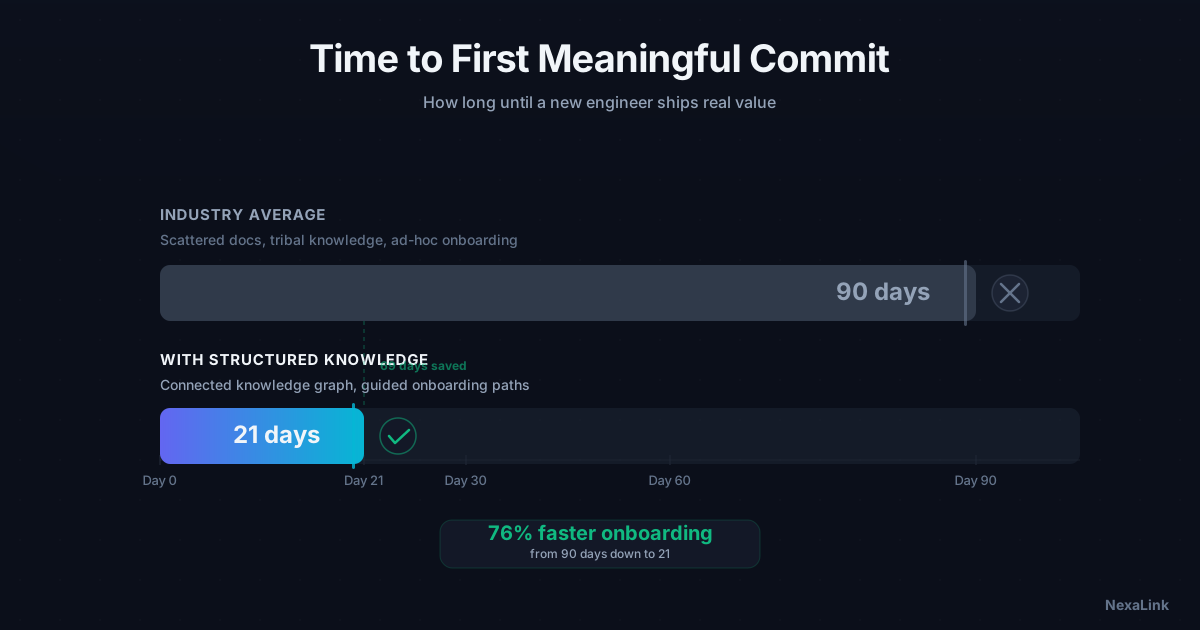
Here’s a benchmark worth knowing: at companies with mature onboarding, the median time to first meaningful commit is 3-5 days. At companies without it, it’s 3-6 weeks. That’s a 5-8x difference for the same engineer, same role, same codebase. The variable isn’t talent. It’s the system around the talent.
Technique 1: Pre-wire the environment
The single biggest time sink in the first week isn’t learning the codebase. It’s waiting for access.
A 2023 report from Okta found that the average company uses 89 SaaS apps. For an engineer, the critical subset is still substantial: version control, CI/CD, cloud console, monitoring, feature flags, internal tooling, communication channels. Every missing permission is a blocked afternoon. Every IT ticket is a context switch.
The fix is unglamorous but effective: a provisioning checklist completed before the start date. Not on day one. Before day one.
The checklist should cover: repo access, CI pipeline credentials, staging and production environment access, monitoring dashboards, documentation platforms, communication channels, and calendar invites for recurring team ceremonies. When this is done right, the new hire opens their laptop on Monday and the only barrier is understanding the code.
Shopify reduced their developer onboarding friction by automating environment setup into a single script. Their internal tool, dev up, installs dependencies, configures services, and runs the test suite in under 10 minutes. The result: new engineers ship code on day one. Not because they’re exceptional. Because the friction was designed out.
Technique 2: Give them a tracer bullet
The worst onboarding assignment is “get familiar with the codebase.” It’s vague, anxiety-inducing, and produces no output. The best onboarding assignment is a tracer bullet - a small, real task that cuts through the entire stack.
A tracer bullet isn’t a toy project or a “getting started” tutorial. It’s a genuine ticket - maybe a small bug fix, a minor UI change, or a config update - that requires the new hire to touch the repo, run the tests, open a PR, get it reviewed, and deploy it. Every step is real. The code ships. And in the process, the new engineer discovers how the build system works, who reviews what, how deploys happen, and where the sharp edges are.
The key constraint: the task should be completable in 1-2 days without requiring deep domain knowledge. You’re optimizing for the engineer’s first full loop through the development cycle, not their first major feature.
Microsoft’s research on developer experience confirms that new developers’ biggest pain points aren’t technical complexity - they’re process opacity. A tracer bullet makes the process visible by forcing the new hire to traverse it end to end.
Technique 3: Replace documentation with guided paths
A wiki with 2,000 pages is not onboarding material. It’s an archive. The difference between a three-month ramp and a three-week ramp is often just the difference between “go read the docs” and “follow this trail.”
Guided paths are curated sequences of knowledge, ordered by what a new hire needs to know and when they need to know it. Not alphabetical. Not organized by team. Organized by the new engineer’s journey from zero context to first contribution.
A typical path looks like:
- Day 1: Team mission, product context, key metrics, who owns what
- Day 2-3: Architecture overview - not comprehensive, just the three services you’ll touch first and how they connect
- Day 4-5: Tracer bullet task (see above), with links to the specific docs needed to complete it
- Week 2: Deeper domain context, team norms, historical decisions that explain current architecture
Each step links directly to the next. Each explanation includes why, not just what. And critically, each step is short. Research on cognitive load shows that learning degrades sharply when working memory is overloaded. Five focused pages beat fifty comprehensive ones.
This is also why chunked, connected knowledge outperforms monolithic documents - smaller units linked together let the learner absorb at their own pace without losing the thread.
Technique 4: Assign a buddy with a script
The buddy system isn’t new. Google’s research showed that assigning a peer buddy reduced new hire ramp time by 25%. But most implementations miss what makes it work: the buddy needs a script, not just a role.
An unstructured buddy relationship decays into “let me know if you have questions.” The new hire, eager to not seem incompetent, doesn’t ask. The buddy, busy with their own work, doesn’t check. Two weeks pass. Nobody learned anything.
A scripted buddy has specific checkpoints:
- End of day 1: “Were you able to pull the repo and run the tests? What blocked you?”
- End of day 3: “What’s the most confusing thing you’ve encountered so far?”
- End of week 1: “What question have you wanted to ask but haven’t?”
- End of week 2: “If you had to explain our architecture to someone, what would you get wrong?”
The last question is particularly powerful. It surfaces misunderstandings before they calcify into incorrect mental models. A study published in the Journal of Applied Psychology found that proactive socialization - where existing team members initiate contact rather than waiting for newcomers to ask - significantly predicted newcomers’ task mastery and social integration.
The buddy’s secondary job is equally important: recording every question the new hire asks that the docs didn’t answer. This creates a feedback loop. Each cohort of new hires makes the path better for the next one.
Technique 5: Make the knowledge graph navigable
Here’s the pattern behind every slow onboarding experience: the new hire needs to understand why the system works the way it does, but the why is scattered across Slack threads, abandoned RFCs, meeting notes, and one senior engineer’s memory.
The architecture doc says “we use event sourcing for the order service.” The new hire’s real question is: why? When was that decided? What were the alternatives? Is it still the right call, or is there a migration planned? This contextual layer - the web of decisions, rationale, and relationships - is what separates “I read the docs” from “I understand the system.”
Most knowledge management tools store documents as flat, independent artifacts. They can’t represent that a decision from last quarter superseded the architecture doc from January. They can’t show that a runbook depends on context from three other documents. Without these connections, the new hire has to reconstruct the relationships manually, through Slack archaeology and interrupting senior engineers.
The teams that onboard fastest have found ways to make these relationships explicit. Whether it’s through diligent cross-linking, decision logs, or a proper knowledge graph, the principle is the same: knowledge isn’t useful in isolation. It’s useful when you can see how it connects. This is the core problem we designed Nexalink around - building a navigable graph of an organization’s knowledge so that the path from question to answer follows the same connections that experts carry in their heads.
The cost of waiting
Every quarter you delay improving onboarding, you’re compounding the cost. Each new hire who spends three months ramping instead of three weeks represents roughly $50K in delayed productivity at a $200K fully-loaded salary. Multiply by your annual hiring rate.
But the harder cost to see is what slow onboarding does to the people who are already there. Every repeat question, every “can you walk me through this,” every pairing session that covers ground already covered last quarter - it’s your senior engineers subsidizing a broken system with their attention.
Start by measuring. Track time to first commit for your next three hires. If it’s over two weeks, you have room to improve. If it’s over a month, you’re leaving significant output on the table. The techniques above don’t require new tooling to start. They require deciding that onboarding speed is a metric worth optimizing.